Showing posts with label Parties. Show all posts
Showing posts with label Parties. Show all posts
Saturday, 13 October 2012
Churros in Trinidad
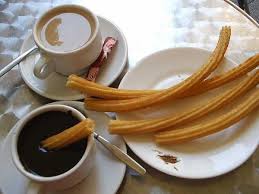
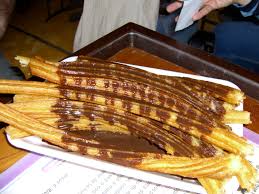
Gigio's Churros on Mucurapo Road, Port-of-Spain is the place to be if you are interested in trying churros. What are churros? Churros are sometimes referred to as a Spanish doughnut, are fried-dough pastries—predominantly choux—based snacks. Churros are popular in Spain, and Latin America (including Spanish-speaking Caribbean islands) and the United States. There are two types of churros in Spain, one which is thin (and sometimes knotted) and the other which is long and thick (porra). They are both normally eaten for breakfast dipped in hot chocolate or café con leche. However, most people who go to Gigio's have churros as a snack.

Trinidad Pastelles (Venezuelan Hallacas)
In Latin American cuisine, an Hallaca (alt. spelling, "hayaca") typically involves a mixture of beef, pork, chicken, raisins, capers and olives wrapped in a dough made from yellow pre-cooked yellow cornmeal, folded with fig leaves, tied with strings, boiled or steamed afterwards. Harina PAN yellow pre-cooked cornmeal or Promasa yellow pre-cooked cornmeal are the most popular brands of cornmeal flour used in making Hallacas. In, Trinidad and Tobago, because of our multiculturalism, and because of our respect for the Muslim, Seventh-day Adventist, and Hindu religions, we do not mix the beef, pork, and chicken together because Hindus do not eat beef and Muslims and Seventh-day Adventists do not eat pork. In Trinidad, the most popular Hallacas are Beef, Chicken and Soya, and Fish is becoming quite popular nowadays. I enjoy making hallacas with lamb filling. Hallacas are traditionally made during the Christmas season.


Pastelle-making in Trinidad is usually done by families around Christmas time and is a wonderful bonding experience. No two families Hallacas (Pastelles) taste the same. Below are some videos showing you how to make Hallacas.
.
Arepas
Arepa is the national dish of both Venezuela and Colombia and is prominent in Latin American cuisine. In some countries it is even referred to as a tamale. The dough mainly consists of white pre-cooked cornmeal flour. The popular cornmeal brand of choice is called Harina PAN and it is sold in Massy Stores, Ridgewood, Arima, Trinidad and Tobago.
Arepas can be bought at Tamryn's on Mucurpo Road, Port of Spain or at Antojostt at the San Antonio Green market in Santa Cruz. They are also usually sold at Indian Expos in the dome, opposite the Centre of Excellence in Macoya.
In Latin America, arepas are made for breakfast and are even sold on the streets by vendors. There are cafes in Venezuela called Areperas, where people can go and have arepas. Arepas can be filled, after they are cooked, with meat, cheese, scrambled eggs, chicken salad, tuna salad, fried plantain an cheese, and black beans and cheese. Below is a picture of an arepa stuffed with stew shredded beef and Queso Blanco (White cheese).

Arepa Recipe
1 cup pre-cooked white cornmeal
1 tsp. salt
1 tbsp. sugar
1 tbsp. margarine or butter
1 1/4 cup warm water
Method
Put the flour, sugar an salt in a bowl; add water little by little while mixing with your hand.
When the dough is at a certain consistency, add the margarine and mix well, the dough should be smooth, firm but not dry and hard.
Form dough into three or six balls(depending on how big you want your arepas to be) of equal size.
Shape and flatten with the palm of your hands into round cakes; arepas should be 1/2 inch thick.Shape edges to smooth.
Pre-heat oven to 350°.
Heat a baking stone/griddle or frying pan on medium heat and coat with corn oil.
Cook for 2 minutes on each side until arepas begin to brown and form a crust.
Transfer arepas to baking sheet coated with corn oil.
Bake at 350° or until arepas sound hollow when lightly tapped.
Cut arepas open and fill with meat, eggs or cheese. Ketchup is a no-no; pepper sauce however compliments it well.
Arepas are usually served for breakfast with a hot cup of coffee or chocolate.
Arepas can be bought at Tamryn's on Mucurpo Road, Port of Spain or at Antojostt at the San Antonio Green market in Santa Cruz. They are also usually sold at Indian Expos in the dome, opposite the Centre of Excellence in Macoya.
In Latin America, arepas are made for breakfast and are even sold on the streets by vendors. There are cafes in Venezuela called Areperas, where people can go and have arepas. Arepas can be filled, after they are cooked, with meat, cheese, scrambled eggs, chicken salad, tuna salad, fried plantain an cheese, and black beans and cheese. Below is a picture of an arepa stuffed with stew shredded beef and Queso Blanco (White cheese).

Arepa Recipe
1 cup pre-cooked white cornmeal
1 tsp. salt
1 tbsp. sugar
1 tbsp. margarine or butter
1 1/4 cup warm water
Method
Put the flour, sugar an salt in a bowl; add water little by little while mixing with your hand.
When the dough is at a certain consistency, add the margarine and mix well, the dough should be smooth, firm but not dry and hard.
Form dough into three or six balls(depending on how big you want your arepas to be) of equal size.
Shape and flatten with the palm of your hands into round cakes; arepas should be 1/2 inch thick.Shape edges to smooth.
Pre-heat oven to 350°.
Heat a baking stone/griddle or frying pan on medium heat and coat with corn oil.
Cook for 2 minutes on each side until arepas begin to brown and form a crust.
Transfer arepas to baking sheet coated with corn oil.
Bake at 350° or until arepas sound hollow when lightly tapped.
Cut arepas open and fill with meat, eggs or cheese. Ketchup is a no-no; pepper sauce however compliments it well.
Arepas are usually served for breakfast with a hot cup of coffee or chocolate.
Subscribe to:
Posts (Atom)